

Does “Grade A” tell you exactly what’s in the jar? Not always. Grade A Afghan saffron may sound like a precise measure, but a label can be hard to interpret unless the seller explains the standard behind it. For Canadian shoppers, comparing that claim with Afghan origin details and other product information can make the choice feel less straightforward.
It’s reasonable to want more than vivid colour or rich aroma descriptions. Sensory details can help, but they’re subjective and don’t replace clear information about how a grade was assigned. This guide explains what the Grade A label can and can’t tell you, how to assess Afghan saffron claims, and which details make product pages easier to compare. You’ll also learn how to use appearance, aroma and flavour as practical clues without treating them as proof on their own.
TrueSource Market brings Grade A Afghan saffron to customers across Canada, with practical saffron education to support considered buying. Read on to make a choice that fits your household with greater confidence.
Key Takeaways
- Learn what the Grade A Afghan saffron label can tell you, and where its limits begin.
- Separate origin, grade, ingredient, and sensory claims to compare listings more clearly.
- Use a simple set of buyer checks to assess the information a product page provides.
- Match your saffron choice to the dishes you plan to make and how often you cook with it.
- TrueSource Market brings Grade A Afghan saffron to customers across Canada.
Grade A Afghan Saffron: What Canadian Buyers Need to Understand
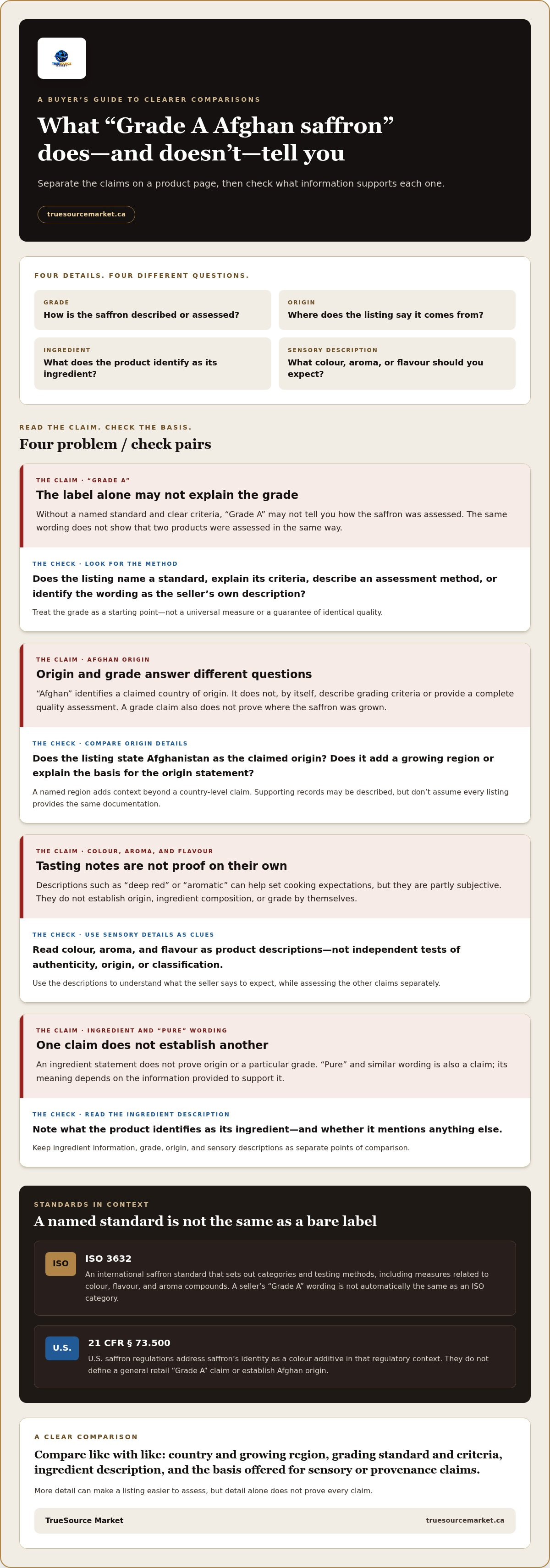
What can the words “Grade A” establish about a jar of saffron? Without a named standard and clear criteria, they may not tell you exactly how the saffron was assessed or how it compares with another product using the same wording. Treat the label as a starting point, then look for an explanation of what it means.
Saffron is made from the dried stigmas of Crocus sativus, the saffron crocus. The Saffron overview describes the plant and its culinary use. For shoppers, that botanical identity is separate from claims about grade and country of origin.
What does Grade A tell a saffron shopper?
Grading terms carry precise meaning when a seller identifies a verifiable standard and explains the criteria used. A product page that simply says “Grade A” gives you wording, but not necessarily the basis for that classification. Look for details that tell you whether the grade refers to a defined standard, a stated assessment method, or the seller’s own description.
This distinction matters when you compare listings. One seller may explain the basis for its grade claim, while another may use the same term without defining it. The phrase alone doesn’t show that the products were assessed in the same way, so avoid treating “Grade A” as a universal measure or a guarantee of identical quality. A dedicated guide to what Grade A means can help unpack the label further when available.
What does Afghan origin add to the product description?
“Afghan” identifies a claimed country of origin. It doesn’t, on its own, describe the grading criteria or establish a complete quality assessment. Likewise, a grade claim doesn’t prove where the saffron was grown. Origin and grade answer different questions: where the product is said to come from, and how its quality is described or assessed.
Keep those claims separate as you read a listing. Check whether the origin wording is specific and whether the grade explanation gives you something concrete to interpret. An origin guide can explore Afghan saffron’s background in more detail when available.
Use these questions to keep the claims distinct:
- Grade: Does the listing name a standard or explain what “Grade A” means?
- Origin: Does it state Afghanistan as the claimed country of origin?
- Evidence: Does the product information explain what supports each claim?
For Grade A Afghan saffron, the label is most useful when the grade wording and origin details are both clear. Read each as a separate part of the product description, not as proof of the other.
How to Read Afghan Saffron Quality Claims Without Guesswork
A product page may combine a country name, a grade, ingredient wording, and appealing tasting notes. These details can help, but they answer different questions. Read each claim on its own terms, then consider whether the information provided gives it a clear basis.
Which details make an origin claim more informative?
A country name tells you the stated national origin. More specific information, such as a growing region, can add context, while a fuller provenance account may explain how that origin is documented. These details aren’t interchangeable: a named region is more specific than a country-level claim, but neither is, by itself, a grade assessment or proof of sensory quality.
Useful substantiation varies. A seller might explain the basis for an origin statement or provide supporting records, while another listing may offer only a country description. Don’t assume every product comes with the same documents. Compare what each page actually says, and note where a claim is detailed versus broad.
How should you interpret colour, aroma, and flavour descriptions?
Colour, aroma, and flavour can help set expectations for cooking, but descriptions are partly subjective. Words such as “deep red” or “aromatic” don’t establish country of origin, ingredient composition, or a grade on their own. Treat them as product descriptions, not independent tests. A dedicated authenticity and quality guide can offer more detail on assessment methods when available.
Ingredient information is another separate check. Read the product description to see what it identifies as the ingredient, and whether it mentions anything else. Avoid treating a simple ingredient statement as evidence of origin or a particular grade. Likewise, a seller’s use of “pure” or similar wording is a claim; its meaning depends on the information provided to support it.
For technical context, ISO 3632 is an international saffron standard that sets out categories and testing methods, including measures related to colour, flavour, and aroma compounds. A seller’s “Grade A” wording isn’t automatically the same as an ISO category. The U.S. Saffron regulations (21 CFR § 73.500) address saffron’s identity as a colour additive in that regulatory context; they don’t define a general retail “Grade A” claim or establish Afghan origin.
To compare Grade A Afghan saffron listings, note the stated country and any growing region, the named grading standard and criteria, the ingredient description, and the basis offered for sensory or provenance claims. Then compare like with like. A listing with more detail is easier to assess, but detail alone doesn’t prove every claim.
Use this framework as you explore Grade A Afghan saffron from TrueSource Market, which brings it to customers across Canada.
Compare Grade A Afghan Saffron Listings Using These Buyer Checks
Once you’ve separated origin, grade, ingredient, and sensory claims, use the same checks on each product page. A simple comparison helps you see what a listing explains clearly and where information is limited. It doesn’t rank products or establish a universal winner.
| Detail to compare | Neutral buyer prompt | What to record |
|---|---|---|
| Origin | Does the page state a country, and does it name a growing region? | Country and any more specific origin detail provided. |
| Grade | Does it explain what “Grade A” means or name a grading method? | The wording used and any criteria or method explained. |
| Ingredient | What does the product description identify as the ingredient? | The ingredient wording, without inferring details that aren’t stated. |
| Format and use guidance | What product format and preparation or use information does the page provide? | Only the stated format and any practical guidance. |
What should you compare on a product page?
Start with the exact wording. A listing that says “Afghan” identifies a country claim; a region adds more location detail. For the grade, look for a plain-language explanation or a named method. Then compare the ingredient description and stated product format. Use guidance can help you understand how the seller expects the saffron to be prepared, but it doesn’t establish origin or grade.
Record what’s present rather than filling gaps with assumptions. If one page gives a country and another names both a country and region, note the difference in specificity. If one explains its grade wording and another doesn’t, record that distinction without treating it as a pass-or-fail result.
How can you weigh evidence against marketing language?
Specific, attributable details are easier to compare than broad superlatives such as “best” or “premium.” For example, “Afghan saffron” states a country claim, while “premium Afghan saffron” adds a positive description but no further origin detail or grading criteria. Similarly, a clear explanation of a grading method gives you more to interpret than “Grade A” alone, though it doesn’t automatically settle every question about the product.
Separate information you can directly identify on the page from subjective language. Colour, aroma, and flavour notes may help you picture the product, but they’re descriptions rather than standalone verification. A page with fewer details isn’t proof of poor quality; it simply gives you less information for a side-by-side assessment.
For Canadian shoppers comparing Grade A Afghan saffron, this framework keeps the decision grounded in what each listing actually says. Use the same prompts across pages, note where claims are explained, and choose based on the information that matters most to your household and cooking plans.
Choose a Saffron Purchase That Fits Your Cooking Plans
A useful purchase decision starts with your kitchen, not with the most elaborate product description. Think about the dishes you want to make, how often saffron will appear in them, and which product details help you choose. Intended use gives context to your comparison: it helps you focus on information that matters for your cooking rather than getting distracted by unrelated claims.
Match the product information to how you plan to cook
Use this short sequence to clarify what you need:
- Identify the dishes. Consider whether you’re planning rice dishes, savoury meals, baking, or beverages. These examples help define how you expect to use saffron, without prescribing a recipe or preparation method.
- Consider frequency. Decide whether saffron is an occasional ingredient or one you expect to use regularly. Your cooking habits can help you think about what product information is relevant to your purchase.
- Compare the details. Review the stated product format, ingredient description, grade wording, and origin information. Focus on details that are clear and useful for your plans, rather than assuming a particular format or claim is automatically a better fit.
For example, someone planning an occasional saffron rice dish may have different priorities from someone who expects to cook with saffron often. Neither pattern is better. The point is to consider your own use before comparing listings, so the information you weigh supports a real choice for your household.
If you want ideas for using saffron in meals, a dedicated saffron cooking guide can provide recipe context. Keep that guidance separate from the buying decision: a recipe can inspire a dish, but it doesn’t establish the product’s origin or explain its grade claim.
Keep buying, cooking, and storage guidance distinct
This section is about selecting a product, not teaching a cooking technique. Details such as how to prepare saffron or store it belong in dedicated cooking and storage guidance, where those topics can be addressed on their own. Avoid choosing based on an assumed preparation method or storage period that a product page doesn’t state.
That separation also makes comparisons clearer. Product details help you assess what a listing says; cooking guidance helps you decide how to use saffron; storage guidance addresses care after purchase. Each serves a different purpose, so one shouldn’t be treated as proof of another.
Once you know what you plan to cook and how often saffron will be part of your routine, compare Grade A Afghan saffron listings against those needs. Explore Grade A Afghan saffron from TrueSource Market, which brings it to customers across Canada.
Find Grade A Afghan Saffron in Canada Through TrueSource Market
After reviewing how grade wording, origin details, and intended use fit together, you can apply that framework to a Canadian offering. TrueSource Market brings Grade A Afghan saffron to customers across Canada. The product name gives you a clear starting point for considering the grade and stated origin, while the buyer checks in this guide can help you assess the details presented with it.
What TrueSource Market offers Canadian saffron buyers
TrueSource Market offers Grade A Afghan saffron to shoppers nationally across Canada. The business also features saffron recipes and a blog, providing practical food-focused reading alongside product information. These resources can support your learning about saffron, while the product description remains the place to review the details relevant to your purchase.
A considered choice doesn’t depend on one phrase alone. As you review the saffron offering, use the same questions you would bring to any product page:
- Interpret the grade: Read “Grade A” as a claim to understand in context, rather than assuming the wording explains every quality measure.
- Assess the origin details: Consider what the product information states about Afghan origin, and distinguish that from the grade description.
- Match the intended use: Think about the dishes you plan to make and how often saffron will be part of your cooking.
- Use the available information: Compare what the product page tells you with the details that matter to your household, without filling in gaps with assumptions.
A straightforward next step for interested buyers
This approach keeps the decision practical. You don’t need to treat promotional wording as a complete quality assessment, and you don’t need to interpret every sensory description as proof. Instead, look at the grade claim, origin information, and cooking plans as separate parts of the decision. The result is a clearer sense of what you know and which details inform your choice.
If you’re still learning how saffron fits into your meals, the site’s recipes and blog offer related educational reading. Use them for cooking inspiration, then return to the product information to consider the purchase itself. Keeping those steps distinct can help you select saffron based on both the details available and the way you expect to use it.
Explore TrueSource Market’s Grade A Afghan saffron when you’re ready to consider the offering for your Canadian kitchen. Take your time, use the buyer checks that matter to you, and make a choice that suits your cooking plans.
Let Your Next Dish Guide Your Choice
A considered saffron purchase can begin with a dish you’re looking forward to making. Let that idea shape what you look for, rather than feeling pressure to choose based on elaborate descriptions or a label alone. The best fit is the one that makes sense for your kitchen and gives you enough product information to make a comfortable decision.
Keep the process at your own pace. You can take time to understand what Grade A Afghan saffron means on a product page, compare the details that matter to you, and decide whether it suits your plans. A clear, informed choice is more useful than chasing a claim that sounds impressive but doesn’t answer your questions.
When you’re ready to take the next step, explore Grade A Afghan saffron from TrueSource Market. Let your curiosity lead, and enjoy bringing a new ingredient into your cooking.
Frequently Asked Questions
Is Grade A saffron an official grade?
“Grade A” isn’t a universal saffron grade unless the seller ties it to a named standard and explains the criteria. ISO 3632, for example, uses categories rather than the label “Grade A.” So treat Grade A Afghan saffron as a product claim whose meaning depends on the explanation provided. A useful listing clarifies the basis for the term instead of relying on the wording alone.
How can I tell if Afghan saffron is authentic?
No simple look, smell, or home test can confirm that saffron was grown in Afghanistan. Read the product description for a clear origin statement and any supporting information it provides. A vivid red colour or strong aroma may describe the threads, but neither proves their country of origin. Treat authenticity as a question of substantiated product information, not a conclusion you can draw from appearance alone.
Does saffron lose its flavour over time?
Yes. Saffron’s aroma and flavour can gradually fade, especially if the threads are repeatedly exposed to air, heat, light, or moisture. That doesn’t mean there’s one reliable freshness timeline for every product. If the aroma seems muted compared with what you expect, the saffron may have lost some of its aromatic character. Buy with your likely use in mind, and avoid keeping more than you expect to use.
How should saffron threads be stored?
Keep saffron threads dry and limit their exposure to air, heat, and light. A tightly closed container in a cool, dark cupboard is a practical choice; avoid leaving the threads beside a stove or in direct sunlight. Moisture can affect dried ingredients, so use a dry utensil when handling them. If the product packaging gives specific storage directions, follow those instructions.
Can I use saffron threads instead of saffron powder?
Often, but don’t assume the same amount will give the same result. Threads and powder differ in form, and recipes may specify one for a reason. Powder disperses through a dish differently, while threads remain visible unless prepared or removed. If adapting a recipe, look for guidance written for the form you have rather than relying on a fixed conversion. Start with the recipe’s instructions and adjust only when appropriate.
Why does saffron colour food differently from the threads themselves?
The threads are concentrated plant material, while their colour spreads through a dish as pigment compounds move into the surrounding liquid or food. Crocin is one of the compounds associated with saffron’s colouring ability. The final shade can vary with the ingredients, cooking process, and amount used. A dish’s colour alone isn’t a dependable way to judge saffron’s origin or grade.
How much saffron should I use in a recipe?
Follow the recipe’s quantity when it specifies one, since the right amount depends on the dish, serving size, and flavour balance you want. There isn’t a single measure that suits every pot of rice, savoury meal, baked dish, or beverage. If the recipe is silent, choose one written for a similar dish and serving size rather than guessing from colour or aroma descriptions.