

What if “Grade A” sounds more exact than it really is? For anyone comparing Grade A Afghan saffron, the label can be a useful starting point, but it doesn’t explain on its own which quality criteria were used. The ISO 3632 standard, for example, uses numbered categories rather than letter grades.
That can make product pages difficult to compare. Origin statements, quality descriptions and sensory words such as “aromatic” may offer clues, but they don’t all provide the same kind of information. It’s reasonable to want clearer details before choosing saffron for your kitchen or as a gift.
This guide explains what grade wording can and can’t tell you, which product details help make claims easier to assess, and how to consider Afghan origin with greater confidence as a Canadian shopper. We’ll look at the role of recognized grading language, practical information to compare across listings, and why sensory descriptions are best considered alongside more specific details. TrueSource Market brings Grade A Afghan saffron to customers across Canada and shares saffron education to help make those choices clearer.
Key Takeaways
- Treat “Grade A” as a starting point, then look for a clear explanation of what the grade represents.
- Compare Afghan origin details, grading information, ingredient statements and sensory descriptions as separate claims.
- Use a practical comparison framework to assess product listings without relying on unsupported scores or a universal winner.
- Consider the dishes you plan to make and how often you cook with saffron before weighing product details.
- TrueSource Market brings Grade A Afghan saffron to customers across Canada.
Grade A Afghan Saffron: What the Label Can and Cannot Tell You
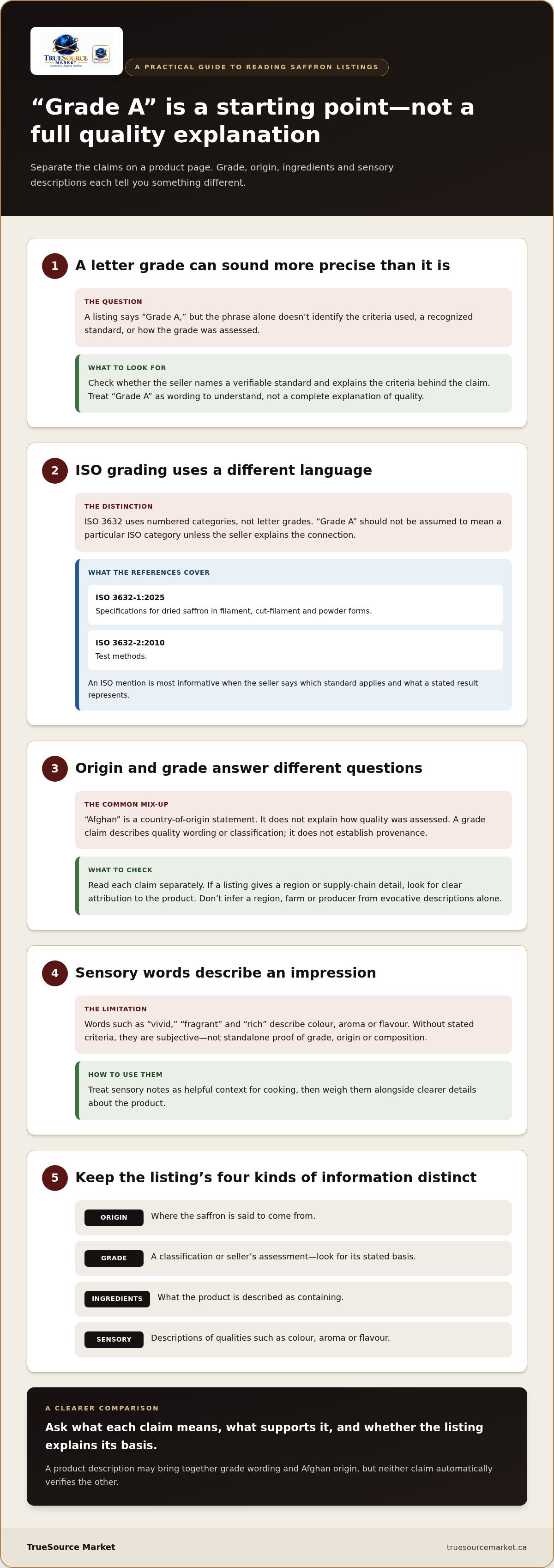
A listing that says “Grade A” may sound precise, but what does that wording establish? By itself, it doesn’t tell you which grading criteria were applied, whether a recognized standard was used, or how the stated grade was assessed. Treat the phrase as a claim to understand, not as a complete explanation of quality.
Saffron is the dried stigmas of Crocus sativus, the flowering plant from which the spice is obtained. The Saffron overview provides background on its cultivation, uses and history. For a buyer, the key distinction is that a product description may use familiar grading language without explaining the basis for that wording.
This video discusses Afghan saffron grading in a product-focused context:
For a more consistent point of comparison, look for the name of a standard and an explanation of how the claim relates to it. ISO 3632 is an international saffron standard. It uses numbered categories, not letter grades. That difference matters: “Grade A” on a listing should not be assumed to mean a particular ISO category unless the seller explains that connection. The wording alone doesn’t establish that a product was assessed against ISO criteria.
What does Grade A mean on a saffron listing?
“Grade A” can be a seller’s descriptive wording. Its meaning depends on the criteria behind it, so look for a named, verifiable standard and details that explain the claim. A clear explanation helps you distinguish a seller’s description from a grade defined by stated criteria. A forthcoming guide to Grade A saffron can explore how to interpret the term in more detail.
Product descriptions can also combine different kinds of information. Keep them separate as you read: a grade describes a quality classification or claim; an origin statement identifies where saffron is said to come from; and sensory words describe qualities such as aroma, taste or colour. One type of statement doesn’t automatically verify another. For example, “Grade A” doesn’t establish Afghan origin, and “Afghan” doesn’t explain how the saffron was graded.
How is Afghan origin different from a grade claim?
“Afghan” identifies a stated country of origin. It answers where the saffron is said to come from, not how its quality was assessed. A grade claim addresses quality wording or classification, not provenance. For a more complete picture, consider each statement on its own and look for information that explains its basis. A planned Afghan saffron origin guide can provide more context on origin descriptions.
In practical terms, Grade A Afghan saffron brings two distinct claims together: one about grade wording and one about origin. Read both carefully. The more clearly a listing explains what each means, the easier it is to compare its information without treating an appealing label as proof of every product detail.
How to Assess Grade and Quality Claims on Afghan Saffron
A product page can make several claims at once, but each answers a different question. Separate them before comparing listings: origin says where the saffron is said to come from; grade wording describes a classification or seller’s assessment; ingredient information identifies what the product contains; and sensory descriptions tell you how its colour, aroma or flavour is presented. None of these claims automatically proves the others.
Specific, attributable details make a claim easier to assess. Look for a named standard, an explanation of the criteria used, clear ingredient wording, and an origin statement with enough context to understand what is being claimed. If a listing refers to testing or documentation, useful context would identify what was assessed and how the information relates to the product. A confident phrase alone doesn’t explain its basis.
The International Organization for Standardization’s catalogue describes ISO 3632-1:2025 as setting specifications for dried saffron in filament, cut-filament and powder forms. It describes ISO 3632-2:2010 as covering test methods. These references help distinguish product specifications from methods of assessment. A mention of ISO is most informative when a seller explains which standard applies and what a stated result represents.
Which details make an origin claim clearer?
A country name is a broad origin statement. A more specific account may identify a region or describe the supply chain, but added detail is useful only when it’s attributable to the product and clearly presented. Look for wording that distinguishes a stated provenance detail from general background about saffron-producing areas. Don’t assume a region, farm or producer from evocative descriptions alone.
For example, “Afghan” names a country, while a named growing region makes a narrower claim. Neither statement, by itself, explains a grade or establishes how the information was determined. Read the wording closely and keep the questions separate: where is the saffron said to originate, and what supports the stated quality assessment?
How should buyers interpret sensory descriptions?
Colour, aroma and flavour can help you picture how saffron may suit cooking, but descriptions such as “vivid,” “fragrant” or “rich” are subjective unless tied to stated criteria. They aren’t standalone proof of grade, origin or composition. Consider tasting notes as descriptive context, then weigh them alongside clearer product information.
Use this quick checklist as you read a listing:
- Origin: Is the country stated, and are any narrower provenance details clearly attributed?
- Grade: Is a standard named, and is the grading claim explained?
- Ingredients: Is the product’s stated ingredient information clear?
- Sensory language: Are colour, aroma and flavour presented as descriptions rather than proof?
For Canadian readers assessing Grade A Afghan saffron, this approach makes product pages easier to compare without relying on a single label or appealing tasting note. Keep track of what each listing states, what it explains and what remains unclear. To continue exploring the subject, use this framework alongside saffron information from TrueSource Market.
Compare Afghan Saffron Listings with a Practical Buyer Framework
Once you’ve separated the types of claims, use the same questions for each listing. A side-by-side comparison can show which details are stated clearly and which are missing. It won’t identify a universal winner, but it can help you decide which listing gives you information that matters for your cooking and confidence as a Canadian buyer.
What information should you compare between listings?
Record the wording rather than assigning a score. Check whether the country of origin is named, whether the grade language is explained, what ingredient information is provided, and whether the listing offers practical use guidance. Compare like with like: a listing that names a grading method and explains its claim gives you a different kind of detail from one that simply uses a grade label.
| Information | Prompts for comparison |
|---|---|
| Origin detail | Is the country stated? Are any narrower provenance details included and clearly attributed? |
| Grade explanation | Is a grading method named? Does the listing explain what its grade claim means? |
| Ingredient information | Does the description state what the product contains? Is the wording clear? |
| Use guidance | Does the listing offer practical direction for using the saffron in food? |
Keep the comparison focused on information, not presentation alone. Product photos, elegant wording and confident claims may catch your attention, but they don’t answer every question in the table. A concise listing may leave some details unstated; that limits what you can compare, but it doesn’t automatically prove poor quality. Treat gaps as unknowns, not as evidence for or against a product.
How can you separate evidence from marketing language?
Give more weight to specific, attributable statements than broad promotional superlatives. A named origin or grading method is a concrete claim you can interpret. Words such as “exceptional” or “premium” express a seller’s view unless the listing explains the criteria behind them. Sensory descriptions can help set expectations, but they’re not a substitute for product details.
For example, “premium Afghan saffron” gives a broad quality impression and names a country. “Afghan saffron, with the grade described according to a named method” gives the reader a clearer basis for understanding the grade claim, though it still doesn’t establish every aspect of quality or origin. The difference is the detail provided, not a guarantee that one product is better.
For a listing described as Grade A Afghan saffron, use this framework to note what’s stated, what’s explained and what remains unclear. Then weigh those details against your intended use. This measured approach helps you compare listings on their information rather than on persuasive language alone.
Choose Grade A Afghan Saffron to Suit Your Cooking Plans
The right comparison starts with your kitchen, not with a label alone. Intended use can guide which product details matter most, whether you’re planning a special rice dish, adding saffron to a savoury meal, baking, or making a beverage. The aim is to choose based on information that fits how you expect to use saffron, rather than on broad claims that don’t address your needs.
Match product information to the dishes you plan to make
Think first about the kinds of dishes you enjoy preparing. A home cook who wants saffron for occasional baking may weigh listing details differently from someone who expects to use it regularly in rice dishes or savoury meals. This doesn’t establish that one grade or format is better for a particular recipe. It helps you focus on the product information that supports your own plans.
Use a simple sequence:
- Identify intended dishes. Name a few likely uses, such as a rice dish, a savoury meal, baking or a beverage.
- Consider frequency. Decide whether saffron is likely to be an occasional ingredient or part of your regular cooking.
- Compare stated details. Review the origin, grade explanation, ingredient information and product format provided in each listing.
This sequence keeps your choice grounded in what you’ll cook, while leaving room to compare product claims without assuming that every listing offers the same information. If you’re still exploring, begin with the dishes you already like and consider whether a product description gives you enough detail to make a considered choice.
Keep selection guidance separate from cooking instructions
Choosing a product and learning how to prepare it are related, but they’re separate decisions. A buyer’s guide can help you compare listing information; a cooking guide can explain techniques such as blooming saffron or using threads. Keep the product choice focused on your plans and the details stated by the seller, rather than expecting a product page to replace a recipe or tutorial.
For instance, a beverage or baking idea may prompt you to look for clear use guidance, while a planned savoury dish may make you focus on whether the listing explains the product format. These are prompts for comparison, not instructions on quantities or preparation. A future saffron cooking guide can offer broader culinary inspiration, with separate guides addressing blooming saffron and using saffron threads when published.
Keep your notes simple: intended dishes, how often you expect to cook with saffron, and which listing details help you assess your options. This framework can make Grade A Afghan saffron easier to consider in the context of a real household, whether you’re choosing for everyday cooking or a meal you’re preparing for guests.
Explore TrueSource Market’s Afghan saffron as you learn more about selecting saffron for your kitchen.
Explore Grade A Afghan Saffron from TrueSource Market
Once you’ve compared product information, the next step is to keep learning at a pace that suits your kitchen. Saffron is an ingredient with a long culinary tradition, and exploring recipes alongside buyer guidance can help you think about how it might fit the dishes you enjoy making.
What TrueSource Market brings to Canadian saffron readers
TrueSource Market’s recipes and blog offer readers ways to explore saffron through food and education. Recipes can provide inspiration for different culinary uses, while blog articles can help build familiarity with the ingredient and the information commonly found in product descriptions. Together, these resources support a curious, practical approach to saffron, whether you’re learning about it for the first time or looking for ideas for your cooking.
Use each resource for a different purpose. A recipe can help you choose a dish to try, while an educational article can add context as you learn about saffron. Keep your own preferences in view as you explore, and treat cooking inspiration as a starting point rather than a substitute for reading product details.
A considered next step for interested readers
Before making your choice, revisit the questions that matter to you. Consider whether the grade wording is explained, whether the origin details are clear, and whether the product information suits the way you plan to cook. You don’t need every listing to answer every question. Focus on the details that help you make a thoughtful decision for your household.
A short note can help: write down what you’re hoping to cook, which product details you find useful, and what you’d like to learn next. This keeps the process grounded in your own needs and makes it easier to explore without relying on promotional language alone.
Take a look through TrueSource Market’s recipes and blog to continue learning about saffron and find inspiration for your kitchen.
Make Your Next Saffron Choice with Confidence
Choosing saffron doesn’t have to mean finding a label that answers every question. A clear, considered choice can start with the information available and leave room to learn as you cook. Let your own kitchen guide what matters most, whether you’re exploring a new dish or choosing an ingredient for a meal you already enjoy making.
As you explore Grade A Afghan saffron, keep curiosity alongside care. Notice which product details help you feel informed, and let those details shape your next step without expecting promotional language to settle every question. Building familiarity with saffron takes time, and each cooking experience can help you understand how it fits your table.
Learn more about Grade A Afghan saffron from TrueSource Market and continue exploring at your own pace. A thoughtful approach makes space for both confidence and discovery.
Frequently Asked Questions
How much saffron should I use in a recipe?
Use the amount specified in the recipe, since recipes differ in serving size and intended flavour. If you’re adapting a dish, begin with less than you think you need, taste as it develops, and make a note for next time. Avoid treating one suggested amount as universal. A recipe written for a large pot of rice, for example, won’t necessarily suit a small batch or a different style of dish.
How do you bloom saffron before cooking?
To bloom saffron, steep the threads in a small amount of warm liquid called for in your recipe, then add the liquid and threads to the dish as directed. The liquid might be water, broth or milk, depending on the preparation. Let the recipe guide the timing and amount; techniques differ. For a step-by-step example, follow a tested recipe such as BBC Good Food’s saffron risotto.
How should saffron threads be stored?
Follow the storage directions on the package. As a general approach for dried ingredients, keep the threads in a closed container in a dry place, away from direct light and heat. Use a clean, dry utensil and close the container after measuring to limit exposure to moisture and air. The National Center for Home Food Preservation’s guidance on dried herbs offers related advice on storing dried plant ingredients.
Does saffron expire or lose its flavour?
Saffron may become less aromatic over time, so follow the package date and storage directions rather than relying on a universal shelf-life estimate. If the threads have little aroma, their flavour may be less noticeable in your cooking. Don’t use saffron if it has become damp or shows visible mould. For packaged food dating and storage guidance, consult the Canadian Food Inspection Agency’s guide to date labels.
Can saffron threads be used to make tea?
Yes. Saffron threads can be steeped in hot water or included in a tea recipe. Follow the recipe’s directions and adjust the amount to your taste, since there isn’t one quantity that suits every cup. If you’re combining saffron with tea or other ingredients, make the infusion to suit the flavour you want. Treat it as a culinary beverage, not as a supplement or treatment for a health concern.
Is it better to buy saffron threads or saffron powder?
Neither form is automatically best for every recipe. Threads are visible in a dish, while powder can be stirred into a mixture; the more useful option depends on the preparation and the form the recipe calls for. Check the product description for the stated ingredient and format. For Grade A Afghan saffron, as with other saffron, don’t assume that threads or powder alone establish the product’s grade or quality.